
-20%

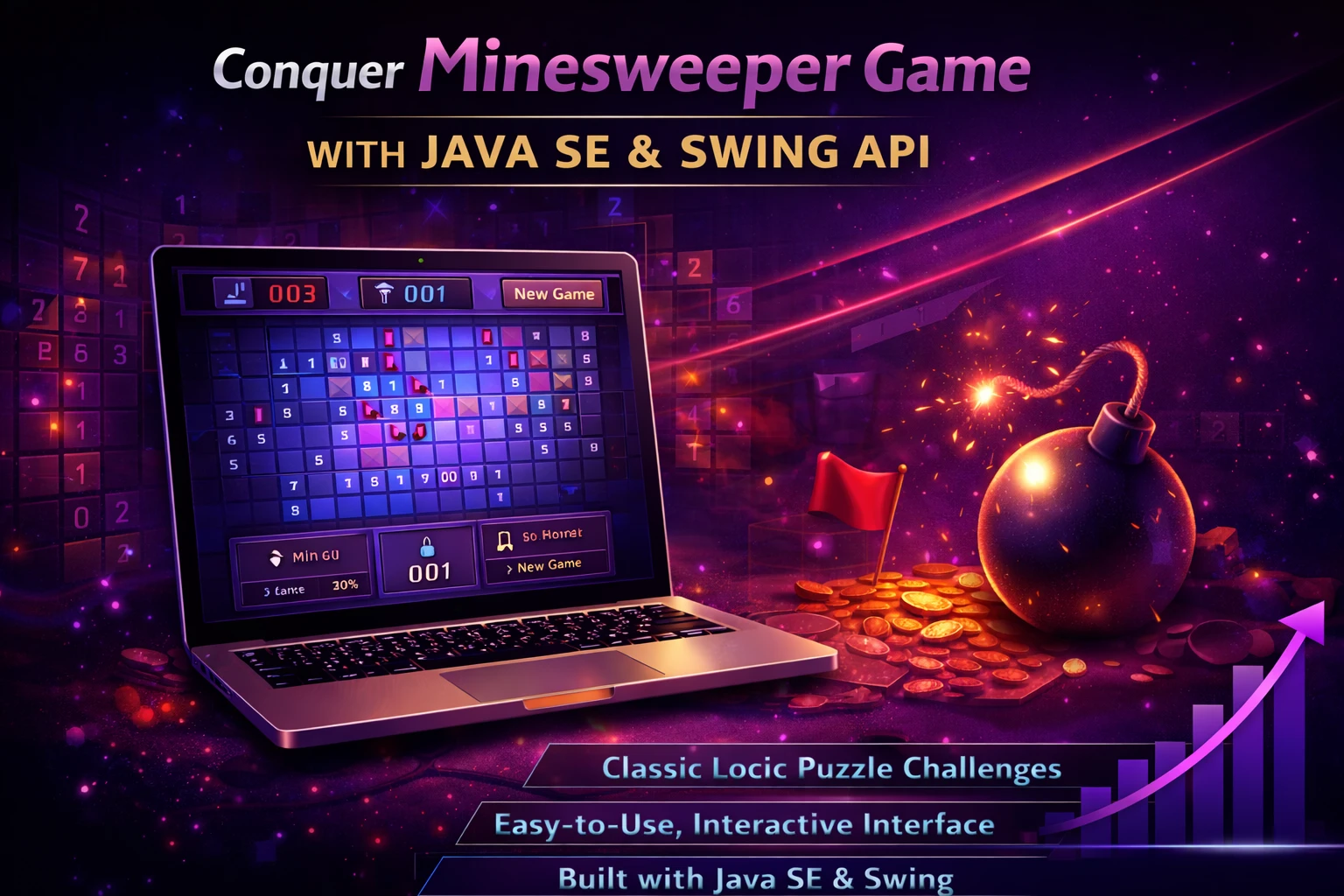
Conquer Minesweeper Game with Java SE and Swing API

0 Orders 0 Wish listed

₹4,999.00

Qty
Total price:
  ₹4,999.00

Detail Description

1. Abstract

Conquer Minesweeper Game with Java SE and Swing API is a desktop-based puzzle game developed to recreate and enhance the classic Minesweeper experience using the Java programming language. The project is built with Java SE for application logic and Swing API for graphical user interface design. Minesweeper is a logic-based game in which the player must reveal all safe cells on a grid while avoiding hidden mines. The game provides numbered clues that indicate how many mines are present in adjacent cells, requiring the player to use reasoning and strategy to progress.

The main aim of this project is to design an interactive, user-friendly, and efficient Minesweeper application that demonstrates the practical use of object-oriented programming concepts, event-driven programming, and GUI development in Java. The system includes features such as clickable grid cells, mine generation, score calculation, restart options, timer support, and win/loss detection. The interface is designed to be simple and intuitive so that users of different age groups can easily play the game.

This project is useful as both an entertainment application and an educational tool for understanding Java desktop application development. It helps demonstrate important programming principles such as arrays, recursion, exception handling, user interaction, and real-time event processing. By implementing the Minesweeper game in Java Swing, the project shows how a classic game can be modeled in software with an effective graphical interface and responsive controls.

Overall, the project provides a complete and functional game system that is reliable, easy to use, and extendable for future improvements such as multiple difficulty levels, sound effects, scoreboards, and theme customization.

2. Objectives

The main objectives of the project are:

  1. To develop a desktop-based Minesweeper game using Java SE.
  2. To create an attractive and interactive graphical user interface using Swing API.
  3. To implement core game logic such as mine placement, clue generation, and safe-cell detection.
  4. To allow the user to interact with the grid through mouse clicks for opening and flagging cells.
  5. To provide game status updates such as win, lose, restart, and score or timer display.
  6. To apply object-oriented programming concepts in a real-time application.
  7. To improve problem-solving and logical reasoning through gameplay.
  8. To create a system that is simple, efficient, and easy to maintain.

3. Existing System

The existing Minesweeper systems are mostly traditional puzzle games available in operating systems or online gaming platforms. These versions generally provide a fixed set of features and limited customization. In some cases, classic Minesweeper games depend on older system environments and may not be flexible enough for academic understanding or modification.

Limitations of Existing System

  1. Many existing versions are platform-dependent.
  2. Some are outdated in appearance and user experience.
  3. Source code is often not available for learning and customization.
  4. Limited scope for adding new features or experimenting with logic.
  5. Some web-based versions require internet access.
  6. Existing systems are primarily focused on gameplay and not on demonstrating software engineering concepts.

Thus, there is a need for a Java-based standalone Minesweeper project that can serve both as a functional game and as an educational software model.

4. Proposed System

The proposed system is a Java Swing-based Minesweeper desktop application that provides a classic grid puzzle game with a modern implementation approach. The application is designed to be standalone, portable, and easy to run on any machine that supports Java.

In this system, the game board is displayed as a grid of buttons or cells. Mines are randomly placed during game initialization. When a user clicks a cell:

  1. If the cell contains a mine, the game ends.
  2. If the cell is safe, the cell reveals a number showing the count of neighboring mines.
  3. If the cell has no adjacent mines, nearby cells are automatically revealed.

The proposed system also supports features like:

  1. New game or restart option
  2. Difficulty levels such as easy, medium, and hard
  3. Timer and mine counter
  4. Flagging suspected mine cells
  5. Win/loss message dialog
  6. Responsive and user-friendly GUI

This system is developed using modular coding practices, making it easier to understand, debug, and enhance in the future.

5. Implementation Procedure

The implementation procedure for the project is as follows:

Step 1: Requirement Analysis

  1. Study the rules and behavior of the Minesweeper game.
  2. Identify the user requirements and game features.
  3. Finalize the scope of the project.

Step 2: System Design

  1. Design the game architecture using Java classes.
  2. Plan the GUI layout using Swing components such as JFrame, JPanel, JButton, and JLabel.
  3. Define the board structure, mine positions, and event-handling logic.

Step 3: Database/Logic Planning

  1. Use 2D arrays to represent the game board.
  2. Store information about mines, revealed cells, and flagged cells.
  3. Implement algorithms for random mine placement and adjacent mine counting.

Step 4: GUI Development

  1. Create the main game window.
  2. Design the board as a matrix of clickable buttons.
  3. Add menu or control buttons for restart, exit, and difficulty selection.

Step 5: Game Logic Implementation

  1. Generate mines randomly when the game starts.
  2. Calculate numbers for cells based on neighboring mines.
  3. Handle left-click and right-click actions.
  4. Implement recursive reveal logic for empty cells.
  5. Add win and loss condition checks.

Step 6: Testing

  1. Test mine placement accuracy.
  2. Test cell reveal functionality.
  3. Test flagging, timer, restart, and end-game conditions.
  4. Fix bugs and improve performance.

Step 7: Deployment

  1. Compile and run the project in Java environment.
  2. Package the application for demonstration or submission.
  3. Prepare project documentation.

6. Software Requirements

The software requirements for this project are:

  1. Operating System: Windows / Linux / macOS
  2. Programming Language: Java
  3. Technology Used: Java SE
  4. GUI Framework: Swing API
  5. IDE: NetBeans / Eclipse / IntelliJ IDEA
  6. JDK Version: JDK 8 or above
  7. Build Tool: Optional, or standard Java compiler
  8. Libraries Required: Standard Java libraries only

7. Hardware Requirements

The hardware requirements for this project are minimal:

  1. Processor: Intel Pentium IV or above
  2. RAM: 2 GB minimum
  3. Hard Disk: 100 MB free space
  4. Monitor: Standard color monitor
  5. Keyboard and Mouse: Required for user interaction

8. Advantages of the Project

The advantages of the project are:

  1. Simple and easy-to-use graphical interface.
  2. Helps users improve logical thinking and decision-making skills.
  3. Platform-independent due to Java support.
  4. Useful for learning Java SE and Swing programming.
  5. Demonstrates real-time event handling and GUI interaction.
  6. Can be extended with more features such as themes, sounds, and scoreboards.
  7. Requires very low hardware and software resources.
  8. Suitable for both entertainment and academic purposes.
  9. Easy to maintain, modify, and debug.
  10. Provides practical exposure to object-oriented programming concepts.


No review given yet!

Fast Delivery all across the country
Safe Payment
7 Days Return Policy
100% Authentic Products

You may also like

View all

Travel Advisor App Using React.js

₹4,999.00

React Admin Dashboard Using Material UI and Chart.js

₹4,999.00

AI Quiz Bot Application Using React.js

₹4,998.99

Antivirus File Scanner Application Using React.js

₹4,999.00

AI OCR Image to Text Extractor Using React.js

₹4,999.00

Conquer Minesweeper Game with Java SE and Swing API
₹4,999.00 ₹0.00
₹4,999.00
4999