
-20%

Domain-Specific Small Language Model using LoRA

0 Orders 0 Wish listed

₹4,999.00

Qty
Total price:
  ₹4,999.00

Detail Description

1. Abstract

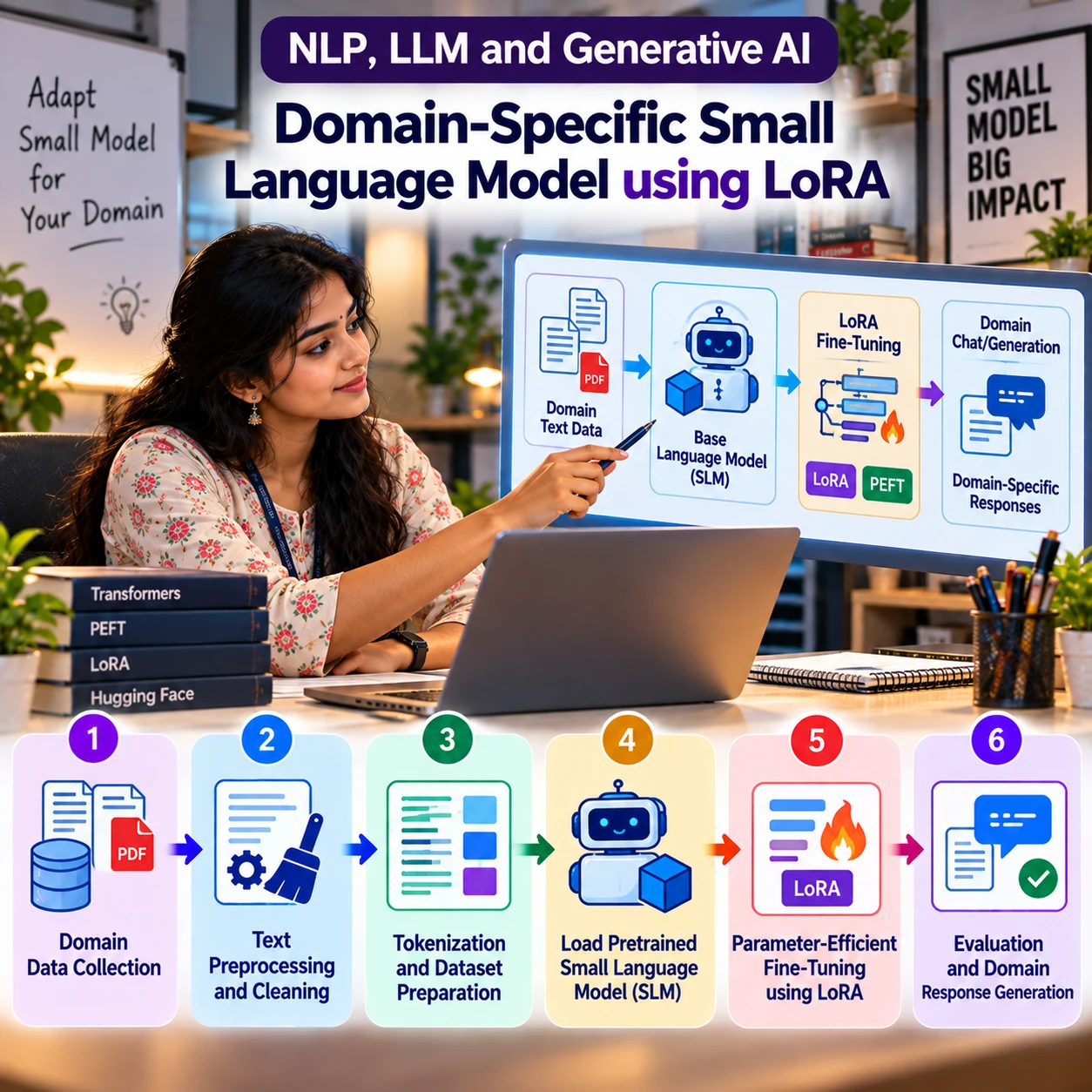
The Domain-Specific Small Language Model (SLM) using Low-Rank Adaptation (LoRA) is a Generative AI project designed to customize a compact pre-trained language model for a specialized domain such as healthcare, education, finance, cybersecurity, or legal information. Instead of training a large language model from scratch, the system uses LoRA, a parameter-efficient fine-tuning technique that updates a small number of additional model parameters while keeping most of the original model weights frozen. Domain-specific datasets are prepared and used to fine-tune the model to improve its responses to specialized questions and tasks. The system provides a user-friendly interface where users can submit queries and receive domain-focused responses. This approach can reduce training costs, memory requirements, and computational overhead compared with full fine-tuning, depending on the model, dataset, and hardware used.

2. Objectives

  1. To develop a compact language model specialized for a selected domain.
  2. To implement LoRA-based parameter-efficient fine-tuning.
  3. To prepare and preprocess domain-specific training datasets.
  4. To improve the model's ability to answer domain-related questions.
  5. To reduce the trainable parameter count compared with full fine-tuning.
  6. To create an interactive interface for submitting queries and viewing responses.
  7. To evaluate model performance using response quality, relevance, and task-specific metrics.
  8. To compare the base model with the LoRA fine-tuned model.

3. Existing System

Traditional domain-specific AI systems often rely on rule-based chatbots, keyword matching, fixed FAQs, or general-purpose language models. Rule-based systems have limited flexibility, while general-purpose models may not consistently follow specialized terminology or domain-specific instructions. Training a language model from scratch requires substantial datasets, computing resources, and development time. Full fine-tuning can also demand significant GPU memory and storage because it updates a large portion or all of the model parameters.

Disadvantages

  1. Limited ability to handle varied domain-specific questions in rule-based systems.
  2. General-purpose models may provide irrelevant or inaccurate domain responses.
  3. Full fine-tuning can require substantial computational resources.
  4. Training a model from scratch is expensive and time-consuming.
  5. Updating specialized behavior can require additional training and evaluation.

4. Proposed System

The proposed system uses a pre-trained Small Language Model and fine-tunes it with LoRA (Low-Rank Adaptation) on a curated domain-specific dataset. LoRA introduces trainable low-rank matrices into selected model layers while the original model weights generally remain frozen. This enables the system to adapt model behavior without updating every parameter.

The system includes data preprocessing, model selection, LoRA configuration, fine-tuning, evaluation, and an interactive inference interface. Users can enter domain-specific questions and receive responses from the adapted model. An optional comparison module evaluates the original model and the fine-tuned model using the same test questions.

Key Features

  1. Pre-trained Small Language Model integration.
  2. Domain-specific dataset preparation and validation.
  3. LoRA-based parameter-efficient fine-tuning.
  4. Configurable rank, alpha, dropout, and learning rate.
  5. Interactive question-answering interface.
  6. Base-model versus fine-tuned-model comparison.
  7. Evaluation of response quality and domain relevance.
  8. Model and adapter saving for later inference.

5. Implementation Procedure

1. Select the domain: Choose a target area such as education, healthcare information, finance, or cybersecurity.

2. Collect the dataset: Prepare domain-specific question-answer pairs, instructions, or task examples from suitable sources. Check data quality, licensing, and privacy.

3. Preprocess the data: Remove duplicates, correct formatting, handle missing values, and convert examples into the model's expected instruction format.

4. Select a pre-trained SLM: Choose a compatible compact model based on its license, language support, context length, and available hardware.

5. Configure LoRA: Use a library such as PEFT to configure the LoRA rank, scaling factor (alpha), dropout, and target model layers.

6. Tokenize the dataset: Convert text into tokens using the tokenizer associated with the selected model. Divide the dataset into training, validation, and test sets.

7. Fine-tune the model: Train the LoRA adapter using a compatible training framework, such as Hugging Face Transformers and PEFT. Monitor training and validation loss.

8. Evaluate the model: Compare the base and fine-tuned models on held-out questions. Assess relevance, factual correctness, instruction following, and domain-specific performance.

9. Build the interface: Develop a web interface using Streamlit or Flask where users can submit queries and view generated responses.

10. Save and deploy: Save the adapter and configuration, load them with the compatible base model, and test inference performance on the intended hardware.

11. Test system reliability: Check incomplete queries, out-of-domain questions, repetitive answers, latency, and unsupported claims. Add suitable warnings or fallback behavior where needed.

6. Software Requirements

ComponentRequirement
Programming LanguagePython 3.10+ or a version supported by the selected libraries
Development EnvironmentVS Code, PyCharm, or Jupyter Notebook
Deep Learning FrameworkPyTorch
Model LibrariesHugging Face Transformers
Fine-Tuning LibraryPEFT
Training UtilitiesTRL or compatible training tools, optionally
Data ProcessingPandas, NumPy, Datasets
TokenizationHugging Face Tokenizers
User InterfaceStreamlit or Flask
EvaluationEvaluate, scikit-learn, and task-specific metrics
Operating SystemWindows with compatible setup, Linux, or cloud notebook environment

7. Hardware Requirements

ComponentMinimum / Suggested Configuration
ProcessorIntel Core i5 or equivalent
RAM8 GB minimum; 16 GB or more recommended
Storage20 GB or more free space, depending on model and dataset
GPUOptional for small experiments; a compatible NVIDIA GPU is recommended for faster fine-tuning
GPU MemoryDepends on model size, sequence length, batch size, quantization, and training configuration
InternetRequired for downloading model files and datasets, unless already available locally

Note: Quantized LoRA methods such as QLoRA may reduce GPU memory requirements. Actual requirements depend on the selected SLM and training setup.

8. Advantages of the Project

  1. Parameter-efficient adaptation: Trains a small set of additional parameters instead of updating the entire base model.
  2. Lower resource requirements: Can reduce training memory and storage needs compared with full fine-tuning.
  3. Domain-focused responses: Adapts the model to the terminology, format, and tasks represented in the training data.
  4. Reusable base model: Multiple domain-specific adapters can potentially share the same compatible base model.
  5. Flexible customization: LoRA settings can be adjusted for different domains and use cases.
  6. Easy experimentation: Enables comparison of different datasets, model sizes, and adapter configurations.
  7. Practical deployment: A trained adapter can be loaded with its compatible base model for inference.
  8. Educational value: Demonstrates practical techniques in Small Language Models, Generative AI, and parameter-efficient fine-tuning.


No review given yet!

Fast Delivery all across the country
Safe Payment
7 Days Return Policy
100% Authentic Products

You may also like

View all

LLM Safety, Toxicity and Prompt-Injection Detection

₹4,999.00

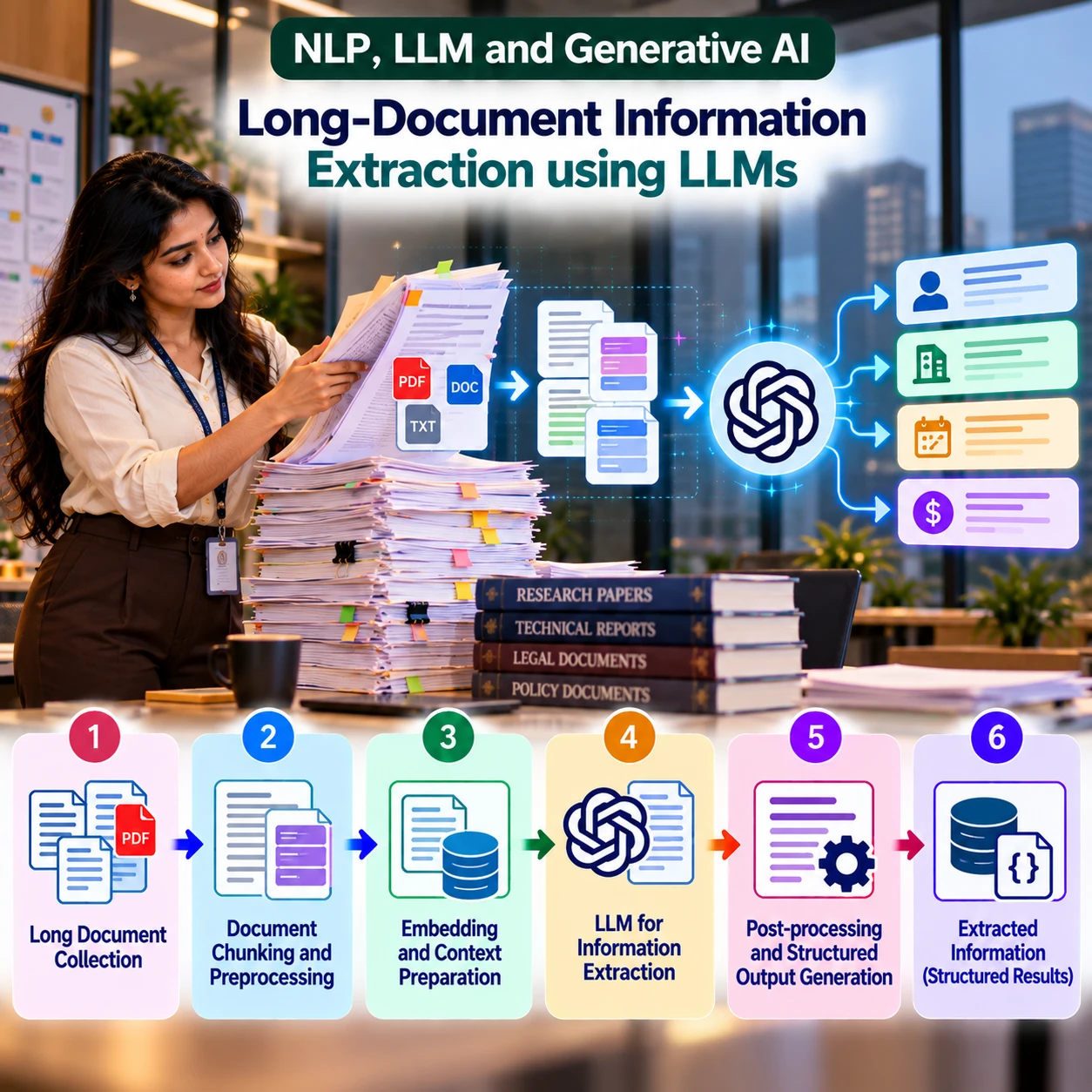
Long-Document Information Extraction using LLMs

₹4,999.00

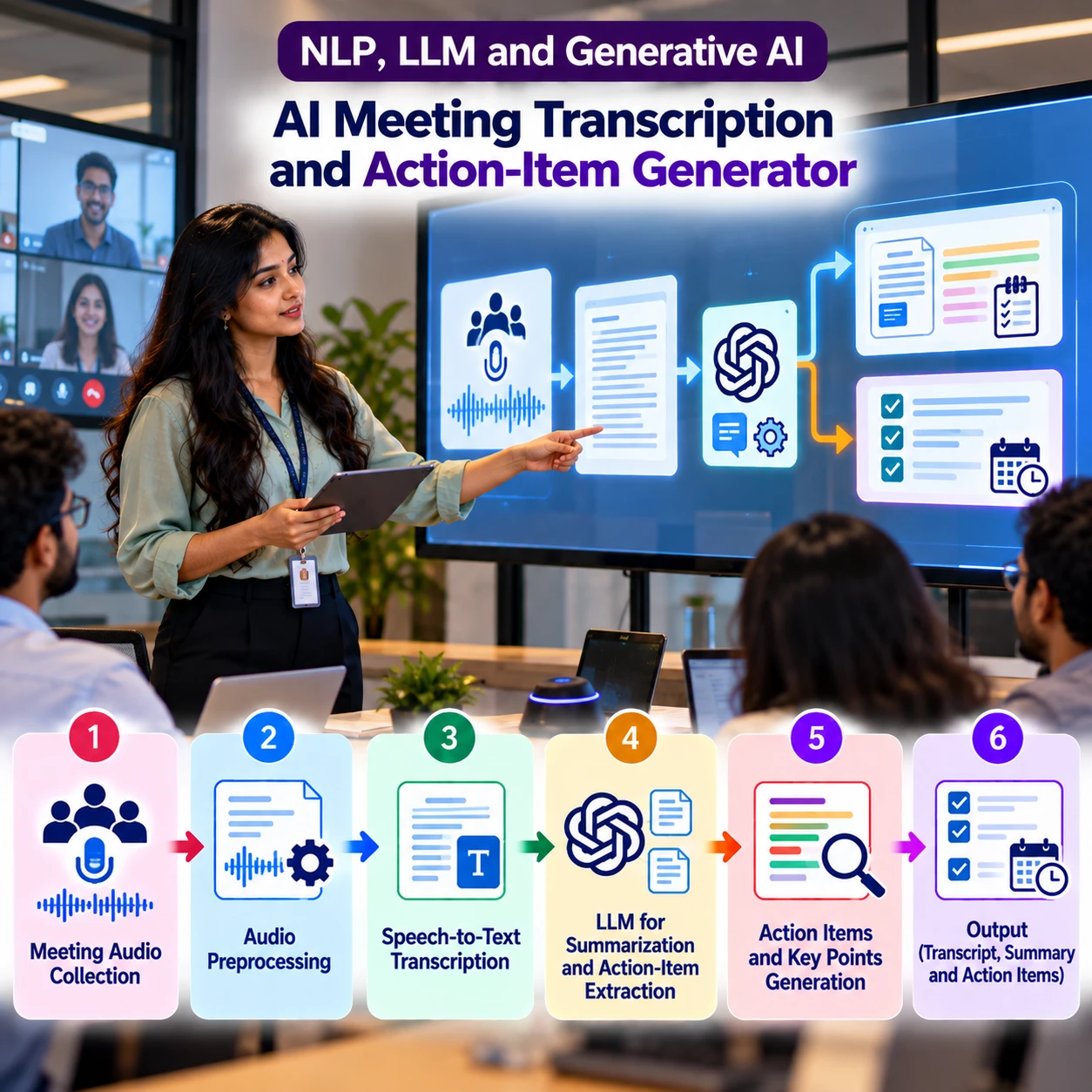
AI Meeting Transcription and Action-Item Generator

₹4,999.00

Explainable Automatic Essay Evaluation

₹4,999.00

LLM-Based Synthetic Dataset Generation

₹4,999.00

Domain-Specific Small Language Model using LoRA
₹4,999.00 ₹0.00
₹4,999.00
4999