
-20%

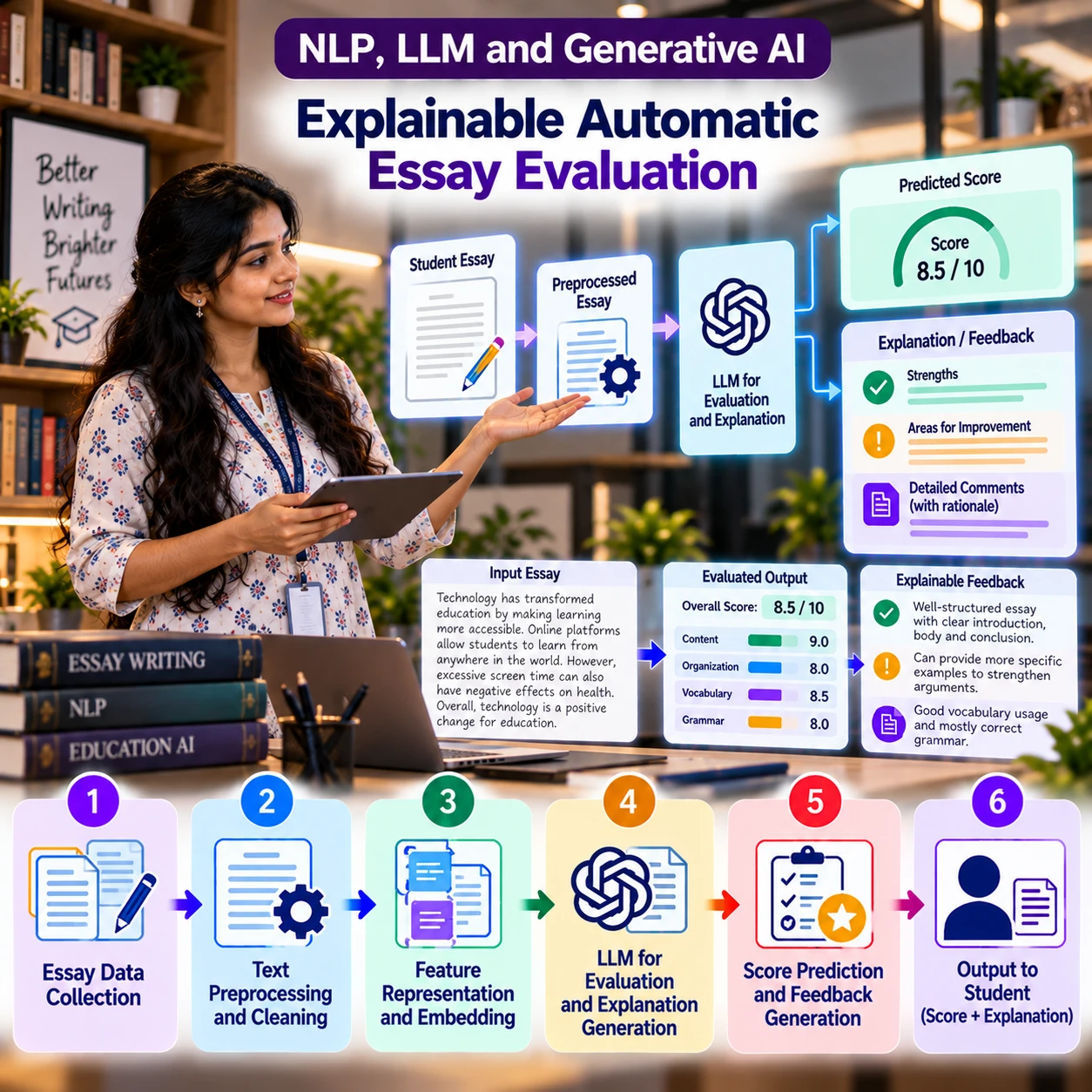
Explainable Automatic Essay Evaluation

0 Orders 0 Wish listed

₹4,999.00

Qty
Total price:
  ₹4,999.00

Detail Description

1. Abstract

The Explainable Automatic Essay Evaluation system is an AI-powered application designed to evaluate student essays automatically using Natural Language Processing (NLP) and Machine Learning (ML). The system analyzes submitted essays based on criteria such as grammar, spelling, vocabulary, relevance, coherence, organization, and overall writing quality. It generates an estimated score and provides understandable feedback explaining the strengths and weaknesses of each essay. Explainability techniques help identify the textual features and evaluation criteria that influence the predicted score. The application can also recommend improvements to help students enhance their writing skills. By combining automated scoring with transparent feedback, the system aims to support teachers, students, and educational institutions in the essay assessment process. The generated scores are intended to assist human evaluators rather than replace their judgment.

2. Objectives

  1. To develop an automated essay scoring system using NLP and ML.
  2. To evaluate essays based on multiple writing-quality criteria.
  3. To predict essay scores using a trained scoring model.
  4. To identify grammatical errors, spelling mistakes, and vocabulary issues.
  5. To analyze essay relevance, coherence, and organization.
  6. To explain the factors influencing the predicted score.
  7. To provide personalized feedback and writing improvement suggestions.
  8. To reduce repetitive manual essay evaluation work.
  9. To evaluate scoring accuracy, consistency, and fairness across different writing styles.

3. Existing System

Traditional essay evaluation relies on teachers or examiners manually reading essays and assigning scores based on predefined rubrics. This process can be time-consuming, particularly when large numbers of essays must be assessed. Basic automated scoring systems use predefined features, keyword matching, or statistical models to estimate scores, but they may not adequately explain their predictions or recognize differences in meaning and writing context.

Disadvantages

  1. Manual evaluation requires considerable time and effort.
  2. Scoring may vary between evaluators.
  3. Basic automated systems may rely heavily on surface-level text features.
  4. Students may receive limited explanations for their scores.
  5. Generic feedback may not address individual writing weaknesses.
  6. Some scoring models may introduce bias against certain writing styles or language backgrounds.

4. Proposed System

The proposed system combines NLP, machine learning, and explainability techniques to evaluate essays and generate transparent feedback. Students submit essays through a web interface, where the text is preprocessed and analyzed for linguistic and structural characteristics. A trained scoring model estimates the essay score, while additional modules evaluate grammar, vocabulary, relevance, coherence, and organization.

Explainability methods such as SHAP, LIME, or feature-based analysis can help indicate which measurable features influenced the score. The application presents the estimated score alongside criterion-wise feedback, highlighted issues, and suggestions for improvement. Where appropriate, a rubric-based scoring approach can be used to make evaluation more consistent and understandable.

Key Features

  1. Essay submission through text input or file upload.
  2. Automatic essay scoring.
  3. Grammar and spelling analysis.
  4. Vocabulary and sentence-structure assessment.
  5. Coherence and organization analysis.
  6. Rubric-based evaluation.
  7. Explainable score predictions.
  8. Highlighted writing strengths and weaknesses.
  9. Personalized improvement suggestions.
  10. Student and evaluator dashboards.
  11. Evaluation history and downloadable reports.

5. Implementation Procedure

1. Collect the dataset: Use an appropriate essay-scoring dataset, such as the ASAP Automated Student Assessment Prize dataset, subject to its usage terms.

2. Preprocess the essays: Remove formatting noise, normalize text where appropriate, and prepare essay text and associated score labels.

3. Define the evaluation rubric: Establish scoring criteria such as content relevance, organization, grammar, vocabulary, and coherence.

4. Extract linguistic features: Use NLP techniques to calculate features such as word count, sentence length, vocabulary diversity, spelling errors, and readability measures.

5. Develop the scoring model: Train a regression or classification model using essay features and human-assigned scores. Suitable algorithms include Random Forest, Gradient Boosting, or transformer-based models.

6. Implement grammar analysis: Integrate a grammar-checking tool or language model to identify possible grammatical and spelling issues.

7. Generate explanations: Use SHAP, LIME, or interpretable feature analysis to explain model predictions. Present these explanations as contributing factors rather than definitive proof of why an essay deserves a score.

8. Calculate criterion-wise feedback: Map model outputs and linguistic analysis to the selected rubric, ensuring that the scoring logic is consistent with the training data.

9. Build the user interface: Develop a Streamlit, Flask, or React-based application for essay submission, score display, explanations, and feedback.

10. Evaluate performance: Measure scoring accuracy using metrics such as Quadratic Weighted Kappa (QWK), Mean Absolute Error (MAE), and Root Mean Squared Error (RMSE), as appropriate.

11. Test fairness and reliability: Evaluate performance across different essay prompts, proficiency levels, and language backgrounds where suitable data is available.

12. Deploy the application: Package the trained model and interface, protect submitted essays, and provide human review for consequential assessments.

6. Software Requirements

ComponentRequirements
Programming LanguagePython 3.10+ or compatible version
Development EnvironmentVS Code, PyCharm, or Jupyter Notebook
NLP LibrariesNLTK, spaCy, or Transformers
Machine Learningscikit-learn
Deep LearningPyTorch or TensorFlow, optionally
ExplainabilitySHAP or LIME
Grammar AnalysisLanguageTool or a compatible service
Data ProcessingPandas and NumPy
VisualizationMatplotlib or Plotly
BackendFlask or FastAPI
FrontendStreamlit or React.js
DatasetEssay texts with human-assigned scores
Operating SystemWindows or Linux

7. Hardware Requirements

ComponentMinimum / Suggested Configuration
ProcessorIntel Core i5 or equivalent
RAM8 GB minimum; 16 GB recommended
Storage10–20 GB free space
GPUOptional for traditional ML; recommended for transformer fine-tuning
GPU MemoryDepends on the selected transformer model
InternetRequired for downloading datasets and using online services

Note: A traditional machine-learning implementation can run on a standard computer. Transformer-based training may require additional GPU memory and computational resources.

8. Advantages of the Project

  1. Faster evaluation: Automates preliminary essay scoring and analysis.
  2. Transparent feedback: Explains relevant factors influencing predicted scores.
  3. Consistent assessment: Applies a defined rubric across submitted essays.
  4. Personalized improvement: Highlights specific areas where students can improve.
  5. Reduced workload: Helps teachers manage large volumes of essays.
  6. Data-driven evaluation: Uses measurable linguistic features and trained scoring models.
  7. Fairness assessment: Supports analysis of scoring consistency across student groups.
  8. Progress tracking: Enables students to compare performance across multiple submissions.
  9. Flexible implementation: Supports traditional ML and transformer-based approaches.
  10. Human oversight: Allows teachers to review scores and resolve ambiguous cases.


No review given yet!

Fast Delivery all across the country
Safe Payment
7 Days Return Policy
100% Authentic Products

You may also like

View all

LLM Safety, Toxicity and Prompt-Injection Detection

₹4,999.00

Long-Document Information Extraction using LLMs

₹4,999.00

AI Meeting Transcription and Action-Item Generator

₹4,999.00

LLM-Based Synthetic Dataset Generation

₹4,999.00

Multilingual Speech and Text Customer-Support Assistant

₹4,999.00

Explainable Automatic Essay Evaluation
₹4,999.00 ₹0.00
₹4,999.00
4999