
-20%

LLM Safety, Toxicity and Prompt-Injection Detection

0 Orders 0 Wish listed

₹4,999.00

Qty
Total price:
  ₹4,999.00

Detail Description

1. Abstract

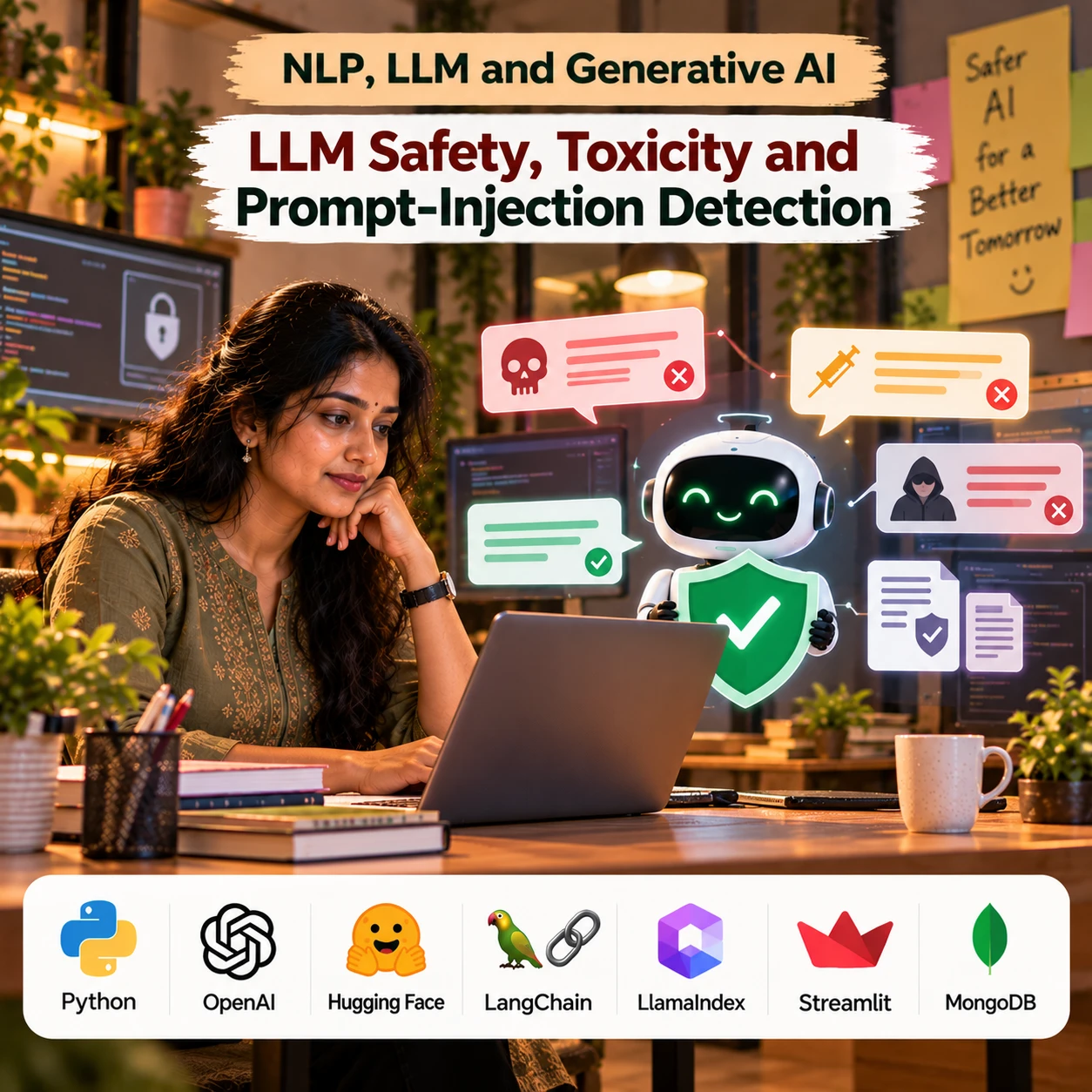
The LLM Safety, Toxicity and Prompt-Injection Detection system is an AI-powered security application designed to identify potentially harmful language, toxic content, and malicious prompt-injection attempts in Large Language Model (LLM) applications. The system analyzes user prompts and model-generated responses using Natural Language Processing (NLP), machine learning, and security-oriented detection rules. It classifies content into categories such as abusive language, hate speech, threats, jailbreak attempts, instruction overrides, and attempts to extract confidential information. The application generates risk scores, explains detected warning signs, and applies configurable safety policies to flag, reject, or route suspicious inputs for additional review. It can be integrated into chatbot and AI application workflows to provide an additional layer of protection. The system supports safer AI interactions but does not guarantee detection of every malicious prompt or harmful response.

2. Objectives

  1. To detect toxic, abusive, and potentially harmful text.
  2. To identify prompt-injection and jailbreak attempts.
  3. To recognize suspicious instructions that attempt to override system policies.
  4. To classify unsafe prompts and responses into predefined categories.
  5. To calculate risk scores for submitted text.
  6. To provide explanations for detected safety risks.
  7. To identify attempts to reveal confidential information.
  8. To integrate safety checks into LLM-based applications.
  9. To evaluate detection accuracy, false positives, and false negatives.
  10. To improve the reliability of AI-assisted content moderation.

3. Existing System

Traditional content moderation systems use keyword filters, blocklists, regular expressions, and basic toxicity classifiers. Although these methods can identify explicit offensive terms, they may struggle with indirect threats, context-dependent language, multilingual content, and sophisticated prompt-injection attempts. Some LLM applications also rely primarily on the language model's built-in safeguards without using a separate input and output monitoring layer.

Disadvantages

  1. Keyword filters can miss disguised or indirect attacks.
  2. Context-dependent toxic language may be misclassified.
  3. Prompt injections can use indirect instructions and obfuscated wording.
  4. Basic filters may produce false positives and false negatives.
  5. Some systems do not inspect both user inputs and model responses.
  6. Limited explanations can make safety decisions difficult to audit.
  7. Static detection rules may require frequent updates.

4. Proposed System

The proposed system combines toxicity classification, prompt-injection detection, rule-based checks, and configurable safety policies. User prompts and LLM-generated responses are analyzed for abusive content, suspicious instruction patterns, jailbreak attempts, and possible data-exfiltration requests.

The system assigns risk categories and scores, provides evidence-based explanations, and applies predefined actions such as allowing the content, displaying a warning, blocking a request, or escalating it for human review. For LLM applications, the detector can operate before a prompt reaches the model and after a response is generated. Additional protections, including tool permissions, output validation, and separation of trusted instructions from untrusted content, help reduce risks that text classification alone cannot prevent.

Key Features

  1. Toxicity and abusive-language detection.
  2. Hate speech and threat classification.
  3. Prompt-injection detection.
  4. Jailbreak-attempt identification.
  5. Suspicious instruction-override detection.
  6. Risk scoring and severity classification.
  7. Explanations for flagged content.
  8. Input and output safety monitoring.
  9. Configurable allow, warn, block, and review policies.
  10. Safety event logging and dashboard analytics.
  11. Optional multilingual content analysis.

5. Implementation Procedure

1. Define safety categories: Establish categories such as toxicity, hate speech, threats, prompt injection, jailbreak attempts, and confidential-data extraction.

2. Collect datasets: Use appropriately licensed toxicity datasets and security-oriented prompt-injection examples. Include benign prompts that resemble attacks to evaluate false positives.

3. Preprocess the text: Normalize input where appropriate, preserve meaningful context, and handle encoding or formatting inconsistencies.

4. Implement toxicity detection: Integrate a pretrained text-classification model or a suitable moderation service to identify potentially toxic content.

5. Develop prompt-injection detection: Combine a classifier with heuristic checks for instruction overrides, requests to ignore previous instructions, suspicious tool-use directives, and attempts to expose hidden prompts.

6. Implement risk scoring: Combine model confidence and rule-based signals into configurable risk levels. Calibrate thresholds using validation data rather than treating raw confidence as a guarantee of safety.

7. Add input and output checks: Analyze user prompts before inference and inspect generated responses before displaying them to users.

8. Create policy enforcement: Configure actions such as allow, warn, block, redact, or escalate based on the detected risk and application requirements.

9. Build the dashboard: Display detected categories, risk scores, explanations, and safety-event summaries.

10. Test adversarial scenarios: Evaluate direct and indirect prompt injections, paraphrased attacks, obfuscated text, benign requests, and multilingual inputs.

11. Measure performance: Calculate precision, recall, F1-score, false-positive rate, and detection latency for each safety category.

12. Deploy securely: Restrict access to logs, avoid storing sensitive prompts unnecessarily, protect credentials, and apply least-privilege controls to any connected tools.

6. Software Requirements

ComponentRequirements
Programming LanguagePython 3.10+ or compatible version
Development EnvironmentVS Code, PyCharm, or Jupyter Notebook
NLP LibrariesTransformers, spaCy, or NLTK
Toxicity DetectionCompatible pretrained classifier or moderation API
Prompt-Injection DetectionCustom classifier, security rules, or compatible detection model
Machine LearningPyTorch or scikit-learn
LLM IntegrationProvider SDK or compatible local model
Data ProcessingPandas and NumPy
BackendFlask or FastAPI
FrontendStreamlit or React.js
DatabaseSQLite or PostgreSQL, optionally
VisualizationPlotly or Matplotlib
Operating SystemWindows or Linux

7. Hardware Requirements

ComponentMinimum / Suggested Configuration
ProcessorIntel Core i5 or equivalent
RAM8 GB minimum; 16 GB recommended
Storage10–20 GB free space, depending on models and datasets
GPUOptional for hosted APIs; recommended for local transformer models
GPU MemoryDepends on model size and inference requirements
InternetRequired for hosted model APIs and online deployment

Note: A lightweight rule-based and API-based implementation can run on a standard computer. Local transformer inference may require additional memory and GPU resources.

8. Advantages of the Project

  1. Enhanced content safety: Helps identify potentially toxic or abusive content.
  2. Prompt-injection awareness: Detects suspicious attempts to manipulate LLM behavior.
  3. Layered protection: Supports input checks, output checks, and policy enforcement.
  4. Risk-based decisions: Categorizes events according to configurable severity levels.
  5. Improved transparency: Provides explanations for flagged content.
  6. Flexible integration: Can be incorporated into chatbots and other LLM applications.
  7. Auditable monitoring: Supports analysis of recurring safety issues.
  8. Customizable policies: Allows different applications to define appropriate thresholds.
  9. Continuous evaluation: Enables testing against new attack patterns and benign examples.
  10. Privacy-conscious design: Can minimize the retention of sensitive prompts and responses.


No review given yet!

Fast Delivery all across the country
Safe Payment
7 Days Return Policy
100% Authentic Products

You may also like

View all

Long-Document Information Extraction using LLMs

₹4,999.00

AI Meeting Transcription and Action-Item Generator

₹4,999.00

Explainable Automatic Essay Evaluation

₹4,999.00

LLM-Based Synthetic Dataset Generation

₹4,999.00

Multilingual Speech and Text Customer-Support Assistant

₹4,999.00

LLM Safety, Toxicity and Prompt-Injection Detection
₹4,999.00 ₹0.00
₹4,999.00
4999