
-20%

Deepfake Generation and Detection Framework

0 Orders 0 Wish listed

₹4,999.00

Qty
Total price:
  ₹4,999.00

Detail Description


1. Abstract

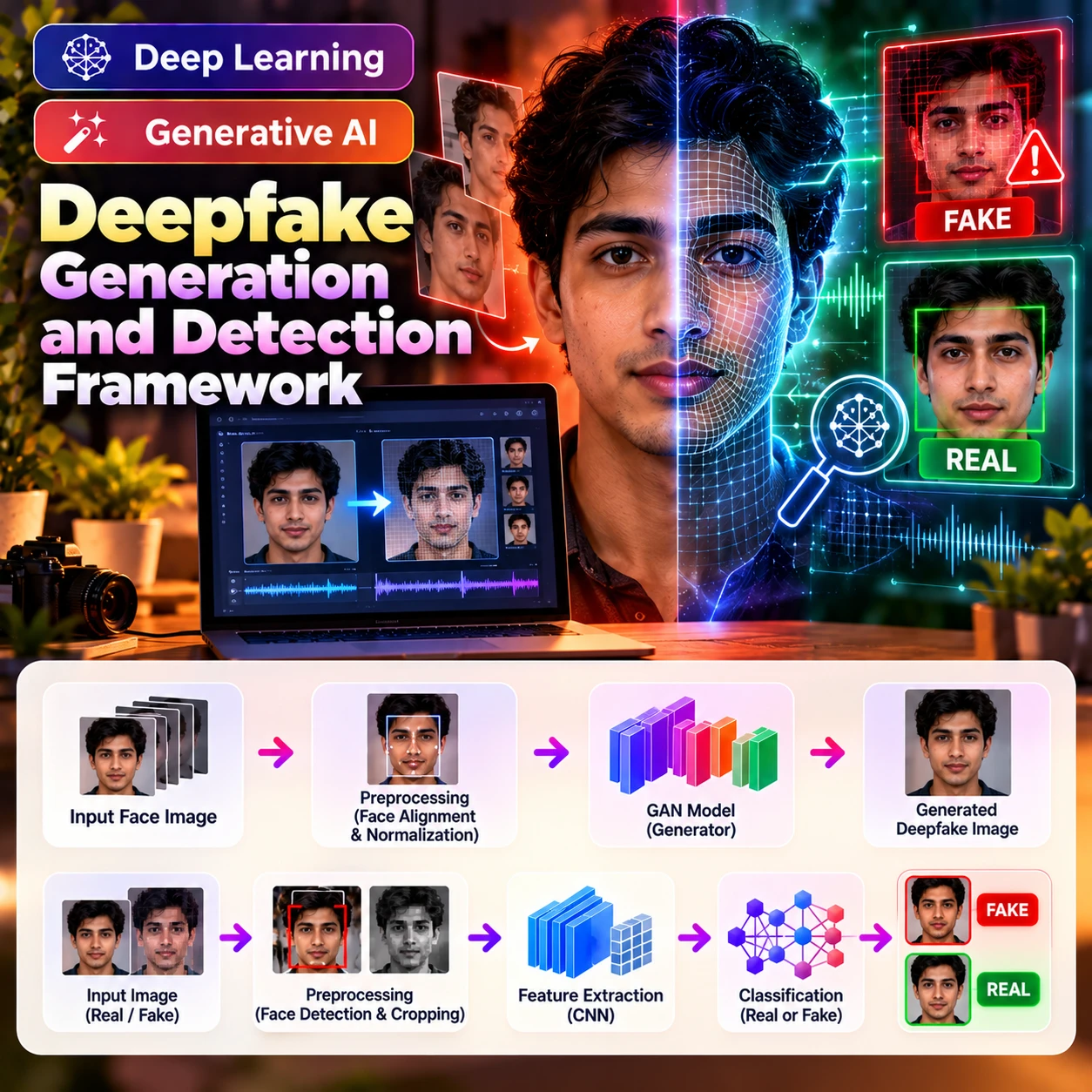
The Deepfake Generation and Detection Framework is an AI-based project designed to study both the generation and detection of synthetic or manipulated media. The system uses Generative AI, deep learning, computer vision, and multimedia analysis to generate controlled synthetic media for research and evaluate whether images or videos have been manipulated. The generation component can use authorized datasets and controlled synthetic transformations, while the detection component analyzes visual artifacts, facial inconsistencies, temporal patterns, compression characteristics, and other forensic features. The framework can support research in media forensics, cybersecurity, misinformation detection, and AI safety. Generated media should be clearly labeled as synthetic and used only with appropriate authorization.

2. Objectives

  1. To develop a framework for studying synthetic-media generation and detection.
  2. To understand how Generative AI can create realistic manipulated media.
  3. To detect potentially manipulated images and videos using deep learning.
  4. To identify visual and temporal artifacts associated with synthetic media.
  5. To analyze facial inconsistencies and unnatural patterns.
  6. To develop an AI-based deepfake classification system.
  7. To compare real and synthetic media characteristics.
  8. To provide confidence scores for detection results.
  9. To evaluate detection performance using standard classification metrics.
  10. To support research in digital media forensics and cybersecurity.

3. Existing System

Traditional deepfake detection systems often rely on manually designed rules, visual inspection, metadata analysis, or fixed forensic signatures. Human reviewers may examine facial movements, image artifacts, lighting inconsistencies, or unusual video behavior.

Modern detection systems increasingly use machine learning and deep learning, but rapidly changing generation techniques can make detection challenging.

Limitations of the Existing System

  1. Manual inspection can be time-consuming.
  2. Human observers may miss subtle manipulation artifacts.
  3. Traditional rule-based approaches may fail against new generation techniques.
  4. Video manipulation requires analysis across multiple frames.
  5. Compression and resizing can hide important forensic artifacts.
  6. New synthetic-media generation methods can reduce the effectiveness of older detectors.
  7. False positives and false negatives remain possible.

4. Proposed System

The proposed framework contains two controlled components:

A. Synthetic Media Generation

A research-oriented generation module creates clearly labeled synthetic samples using authorized data and suitable generative models.

Possible technologies include:

  1. GANs
  2. Diffusion models
  3. Autoencoders
  4. Face-generation models
  5. Controlled image-to-image models

B. Deepfake Detection

The detection module analyzes uploaded images or videos and predicts whether they are likely to be real or manipulated.

Possible detection techniques include:

  1. CNN-based classifiers
  2. Vision Transformers
  3. EfficientNet
  4. ResNet
  5. Temporal CNN/LSTM models
  6. 3D CNNs
  7. Transformer-based video models
  8. Frequency-domain analysis
  9. Facial landmark analysis

The overall workflow is:

Media Input → Preprocessing → Frame/Face Extraction → Feature Extraction → Deepfake Detection Model → Classification → Confidence Score

For videos:

Video → Frame Sampling → Face Detection/Alignment → Spatial Features → Temporal Features → Classification → Result

5. Implementation Procedure

Step 1: Dataset Collection

Use appropriately licensed deepfake datasets containing real and manipulated media.

Examples include research datasets such as FaceForensics++, Celeb-DF, or other suitable datasets.

Step 2: Data Preprocessing

For images:

  1. Resize images.
  2. Normalize pixel values.
  3. Detect and crop faces.
  4. Align faces where appropriate.

For videos:

  1. Extract selected frames.
  2. Detect faces.
  3. Align and resize facial regions.
  4. Preserve temporal ordering.

Step 3: Controlled Synthetic Data Generation

Generate research samples using an authorized dataset and clearly mark generated outputs as synthetic.

The generation module should be isolated from real-world impersonation workflows.

Step 4: Feature Extraction

Extract relevant characteristics such as:

  1. Facial texture
  2. Blending artifacts
  3. Lighting inconsistencies
  4. Facial landmarks
  5. Edge artifacts
  6. Frequency-domain features
  7. Compression patterns
  8. Temporal inconsistencies

Step 5: Detection Model Development

Train a classifier using real and manipulated samples.

Possible models include:

  1. CNN
  2. ResNet
  3. EfficientNet
  4. Vision Transformer
  5. 3D CNN
  6. CNN-LSTM
  7. Video Transformer

Step 6: Model Training

Split the dataset into training, validation, and testing sets while avoiding leakage between related videos or identities.

Train the model to classify media as:

Real / Manipulated

Step 7: Model Evaluation

Evaluate the detector using:

  1. Accuracy
  2. Precision
  3. Recall
  4. F1-score
  5. Specificity
  6. ROC-AUC
  7. Confusion Matrix

For video detection, evaluate performance across videos rather than treating every frame as an independent sample.

Step 8: Robustness Testing

Test the detector under realistic transformations such as:

  1. Compression
  2. Resizing
  3. Cropping
  4. Noise
  5. Different resolutions

This helps determine whether the detector generalizes beyond the original dataset.

Step 9: Application Development

Create a web interface using Streamlit, Flask, FastAPI, or React.

Users can upload an authorized image or video and receive:

  1. Real/Manipulated prediction
  2. Confidence score
  3. Frame-level analysis where applicable
  4. Visual explanation/heatmap where supported
  5. Detection summary

Step 10: Responsible Output

Clearly state that the result is an AI-based forensic assessment, not definitive proof of authenticity. Generated samples should remain clearly labeled as synthetic.

6. Software Requirements

RequirementTechnology
Programming LanguagePython
Development EnvironmentVS Code / Jupyter / Google Colab
Deep LearningPyTorch / TensorFlow / Keras
Computer VisionOpenCV
Face DetectionMTCNN / RetinaFace / MediaPipe
Image ProcessingPillow
Video ProcessingOpenCV / FFmpeg
ModelsCNN / ResNet / EfficientNet / ViT
Temporal AnalysisLSTM / 3D CNN / Video Transformer
Data ProcessingNumPy / Pandas
VisualizationMatplotlib / Plotly
EvaluationScikit-learn
Web InterfaceStreamlit / Flask / FastAPI / React
DatasetAuthorized Deepfake Research Dataset
BrowserGoogle Chrome / Microsoft Edge
Operating SystemWindows / Linux / macOS

7. Hardware Requirements

  1. Processor: Intel Core i5 or equivalent
  2. RAM: Minimum 8 GB
  3. Recommended RAM: 16 GB or higher
  4. Storage: Minimum 30 GB free space
  5. GPU: NVIDIA GPU with sufficient VRAM recommended for deep learning
  6. Display: 1366 × 768 or higher
  7. Keyboard and Mouse: Required
  8. Internet: Required for datasets, libraries, and model downloads
  9. Cloud GPU: Google Colab or another GPU-enabled platform can be used for training.

8. Advantages of the Project

  1. Combines synthetic-media generation and detection research.
  2. Helps understand modern deepfake-generation techniques.
  3. Automatically analyzes potentially manipulated media.
  4. Supports image and video deepfake detection.
  5. Can analyze spatial and temporal manipulation artifacts.
  6. Provides quantitative detection metrics.
  7. Useful for cybersecurity and digital forensics research.
  8. Supports misinformation and media-integrity research.
  9. Can be extended to newer AI-generated media techniques.
  10. Provides an interactive detection interface.
  11. Can support research into robust deepfake detection systems.


No review given yet!

Fast Delivery all across the country
Safe Payment
7 Days Return Policy
100% Authentic Products

You may also like

View all

Blockchain-Based Model Ownership Verification

₹4,999.00

Decentralized Federated Learning

₹4,999.00

Cryptocurrency Fraud Detection

₹4,999.00

Smart Contract Vulnerability Detection using ML

₹4,999.00

Blockchain-Based E-Voting

₹4,999.00

Deepfake Generation and Detection Framework
₹4,999.00 ₹0.00
₹4,999.00
4999