
-20%

Synthetic Medical Image Generation using GANs

0 Orders 0 Wish listed

₹4,999.00

Qty
Total price:
  ₹4,999.00

Detail Description

1. Abstract

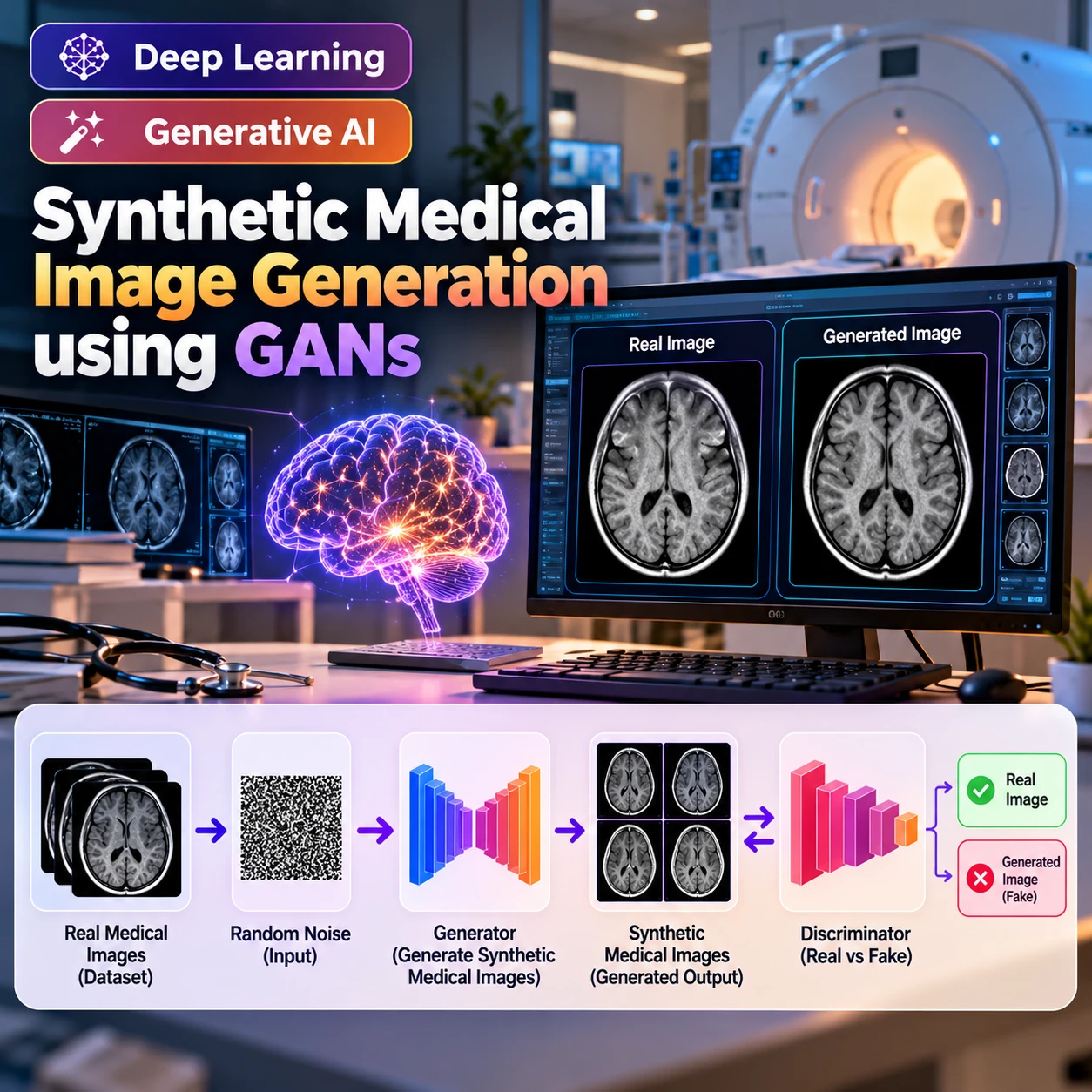
Synthetic Medical Image Generation using GANs is a Generative AI project that creates realistic synthetic medical images using Generative Adversarial Networks (GANs). The system consists of a Generator that creates synthetic images and a Discriminator that evaluates whether an image is real or generated. Through adversarial training, the generator gradually learns the visual characteristics and distribution of the training medical images. The system can be applied to medical image research, dataset augmentation, model development, and educational purposes. Depending on the dataset, the project can generate synthetic images resembling X-rays, MRI scans, CT images, ultrasound images, or other medical imaging modalities. Generated images should be carefully validated and are not intended for clinical diagnosis.

2. Objectives

  1. To generate realistic synthetic medical images using GANs.
  2. To understand and implement Generative Adversarial Networks.
  3. To train a Generator and Discriminator using medical image datasets.
  4. To learn important visual patterns and characteristics from medical images.
  5. To address limited medical-image dataset availability for research.
  6. To augment existing datasets with synthetic samples.
  7. To investigate the usefulness of synthetic images for AI model development.
  8. To visualize and compare real and generated medical images.
  9. To evaluate the quality and diversity of generated images.
  10. To develop a user-friendly interface for generating and viewing synthetic images.

3. Existing System

Traditional medical AI systems generally depend on large collections of real medical images for training and validation. However, medical datasets can be difficult to obtain because of privacy requirements, limited availability, expert annotation requirements, and data-sharing restrictions.

Researchers may use conventional data augmentation techniques such as rotation, flipping, cropping, scaling, and brightness adjustments to increase dataset size. However, these transformations generally modify existing images rather than creating completely new samples.

Limitations of the Existing System

  1. Limited availability of medical imaging datasets.
  2. Medical images can require expert annotation.
  3. Patient privacy and data-sharing restrictions can limit dataset access.
  4. Manual collection and annotation can be expensive and time-consuming.
  5. Conventional augmentation produces variations of existing images.
  6. Rare medical conditions may have fewer available samples.
  7. Large-scale medical AI research can require substantial amounts of data.

4. Proposed System

The proposed system uses Generative Adversarial Networks (GANs) to generate synthetic medical images that resemble the characteristics of real training data.

The basic workflow is:

Medical Image Dataset → Preprocessing → GAN Training → Generator → Synthetic Image → Quality Evaluation

The GAN contains two main components:

Generator

The Generator receives random noise or a latent vector and attempts to create a synthetic medical image that resembles the training data.

Discriminator

The Discriminator receives both real and generated images and attempts to distinguish between them.

Through adversarial training, both networks improve:

Random Noise → Generator → Synthetic Medical Image

Real/Synthetic Image → Discriminator → Real or Generated

Possible GAN architectures include:

  1. DCGAN
  2. Conditional GAN (cGAN)
  3. WGAN
  4. WGAN-GP
  5. StyleGAN
  6. Progressive GAN

For class-specific generation, a Conditional GAN can be used to generate images corresponding to selected categories.

5. Implementation Procedure

Step 1: Dataset Collection

Collect a suitable medical imaging dataset such as:

  1. Chest X-rays
  2. Brain MRI
  3. CT scans
  4. Ultrasound images
  5. Dermoscopic images

Use appropriately licensed datasets and follow applicable privacy and ethical requirements.

Step 2: Data Preprocessing

Perform preprocessing operations such as:

  1. Removing corrupted images.
  2. Resizing images.
  3. Normalizing pixel values.
  4. Converting images to the required format.
  5. Organizing images into appropriate classes when required.

Step 3: Dataset Exploration

Analyze:

  1. Number of images.
  2. Image dimensions.
  3. Class distribution.
  4. Pixel-value distribution.
  5. Sample medical images.

Step 4: GAN Architecture Development

Implement the Generator and Discriminator using PyTorch or TensorFlow/Keras.

The Generator learns to create synthetic medical images, while the Discriminator learns to distinguish real images from generated images.

Step 5: GAN Training

Train both networks iteratively.

Noise → Generator → Synthetic Image → Discriminator

The Generator attempts to improve its generated images while the Discriminator becomes better at identifying generated samples.

Step 6: Monitor Training

Track:

  1. Generator loss
  2. Discriminator loss
  3. Generated image quality
  4. Training stability
  5. Sample diversity

Save generated samples at different training stages.

Step 7: Generate Synthetic Images

After training, provide random latent vectors to the Generator to create new synthetic medical images.

Step 8: Image Quality Evaluation

Evaluate generated images using appropriate methods such as:

  1. Visual inspection by qualified reviewers where appropriate
  2. FID (Fréchet Inception Distance)
  3. KID (Kernel Inception Distance)
  4. SSIM where meaningful for the task
  5. Diversity analysis
  6. Distribution comparison

For medical applications, domain-specific validation is particularly important because visually realistic images may still contain clinically unrealistic artifacts.

Step 9: Application Development

Develop an interface using Streamlit, Flask, FastAPI, or React where users can generate and view synthetic images.

Step 10: Dataset Augmentation

If validated for the intended research purpose, generated images can be combined with real training data to investigate whether synthetic data improves downstream medical-image classification or other AI tasks.

6. Software Requirements

RequirementTechnology
Programming LanguagePython
Development EnvironmentVS Code / Jupyter / Google Colab
Deep LearningPyTorch / TensorFlow / Keras
GAN FrameworkPyTorch / TensorFlow
Image ProcessingOpenCV / Pillow
Data ProcessingNumPy / Pandas
Machine LearningScikit-learn
VisualizationMatplotlib / Plotly
EvaluationFID / KID / SSIM where appropriate
Web InterfaceStreamlit / Flask / FastAPI / React
DatasetMedical Imaging Dataset
BrowserGoogle Chrome / Microsoft Edge
Operating SystemWindows / Linux / macOS

7. Hardware Requirements

  1. Processor: Intel Core i5 or equivalent
  2. RAM: Minimum 8 GB
  3. Recommended RAM: 16 GB or higher
  4. Storage: Minimum 30 GB free space
  5. GPU: NVIDIA GPU with sufficient VRAM strongly recommended for GAN training
  6. Display: 1366 × 768 or higher
  7. Keyboard and Mouse: Required
  8. Internet: Required for downloading datasets, libraries, and pretrained models
  9. Cloud GPU: Google Colab or another GPU-enabled cloud platform can be used for training.

8. Advantages of the Project

  1. Generates synthetic medical images automatically.
  2. Can supplement limited research datasets.
  3. Helps investigate AI model development with synthetic data.
  4. Can support research on rare or underrepresented classes when appropriately validated.
  5. Reduces dependence on repeatedly collecting new images for certain research experiments.
  6. Provides an effective demonstration of Generative AI.
  7. Can be used for medical-image data augmentation research.
  8. Supports experimentation with different GAN architectures.
  9. Allows researchers to study image-generation quality and diversity.
  10. Can be extended to conditional and class-specific image generation.
  11. Useful for educational and research applications in medical AI.


No review given yet!

Fast Delivery all across the country
Safe Payment
7 Days Return Policy
100% Authentic Products

You may also like

View all

AI Resume Builder

₹4,999.00

College Knowledge-Base Chatbot

₹4,999.00

Data Lake-Based Healthcare Analytics

₹4,999.00

AutoML Platform for Tabular Data

₹4,999.00

Edge–Cloud AI Inference System

₹4,999.00

Synthetic Medical Image Generation using GANs
₹4,999.00 ₹0.00
₹4,999.00
4999